

Run your first analysis within 5 minutes of signing up. Tell us about your product and category, and we automatically generate relevant prompts based on how real buyers search for solutions like yours.
People ask AI what to buy. Are you in the answer?
Discover who AI recommends in your category, why you're missing, and exactly what to fix. Updated daily.
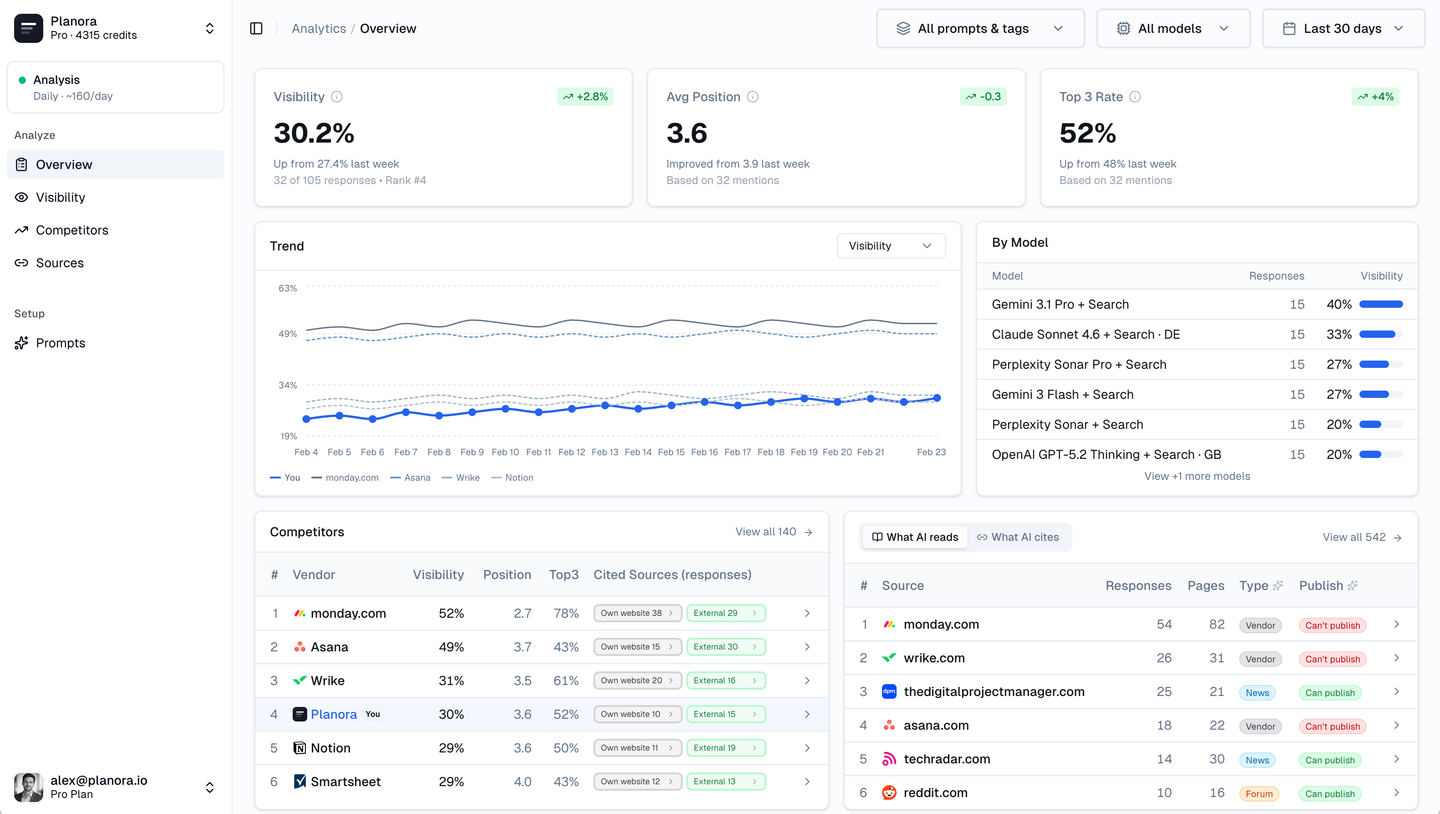
Interactive demo with sample data for illustration purposes. Company names are used as realistic examples and do not reflect actual AI search performance. Trademarks belong to their respective owners.
You can't improve what you can't see
When someone asks an AI "what's the best tool for X?" - you have no idea if you're in the answer. Or why. Or what sources influenced the recommendation.
Without BASEBRIGHT Flying blind
- No idea which prompts to test
- Can't see who AI recommends or why
- No clue which sources drive citations
- Guessing where to invest content efforts
With BASEBRIGHT Full visibility
- Research-backed prompts generated in one click
- See who gets mentioned across all AI models
- Know exactly which sources drive citations
- Prioritized action plan, tracked over time
The question isn't whether these gaps exist. It's whether you'll find them first.
From zero to insights in minutes
See what AI says about your category - and what to do about it.
You don't need to know what to ask
Our prompt generation algorithm analyzes your product, positioning, and competitive landscape, then generates prompts that cover the full semantic space around your category - the discovery questions, the comparisons, the problem-to-solution scenarios where a buyer's intent leads to your product.
About our prompt methodology
Basebright's prompt generation engine was developed in consultation with researchers studying real AI user behavior. It produces two tiers of synthetic queries - short discovery prompts (10–30 words) and detailed first-person buyer scenarios (60–140 words) - reflecting the bimodal prompting behavior observed in empirical studies of ChatGPT usage.
Each prompt is classified by intent type: informational queries ("what's best for my situation"), alternative-seeking queries ("what are the alternatives to X"), task-based queries ("what solves this specific problem"), and underspecified category searches. Intent distribution is calibrated to match real-world AI conversation patterns.
Before generating prompts, the algorithm extracts your business context: business model, buyer personas, decision complexity, emotional triggers, and constraint signals relevant to your market. Prompts are then generated across a persona-by-constraint matrix and validated to ensure every query is commercially framed - answerable with specific product recommendations, not generic advice.
Research informing this approach:
- - AI conversations carry distinct intent taxonomies that traditional search classifications fail to capture (Shah et al., 2025, ACM Transactions on the Web)
- - Analysis of real ChatGPT conversations reveals a bimodal prompt length distribution, with median prompts of 15 words and mean prompts of 86 words, confirming two distinct querying behaviors (empirical study of 5,000+ ChatGPT conversations, 2023)
- - 49% of ChatGPT interactions involve users seeking guidance and recommendations, representing the primary query space for brand visibility (Chatterji et al., 2025, NBER Working Paper No. 34255)
- - Generative Engine Optimization research demonstrates that targeted content strategies can increase brand visibility in AI-generated responses by up to 40% (Aggarwal et al., 2024, ACM SIGKDD)
See where you actually stand
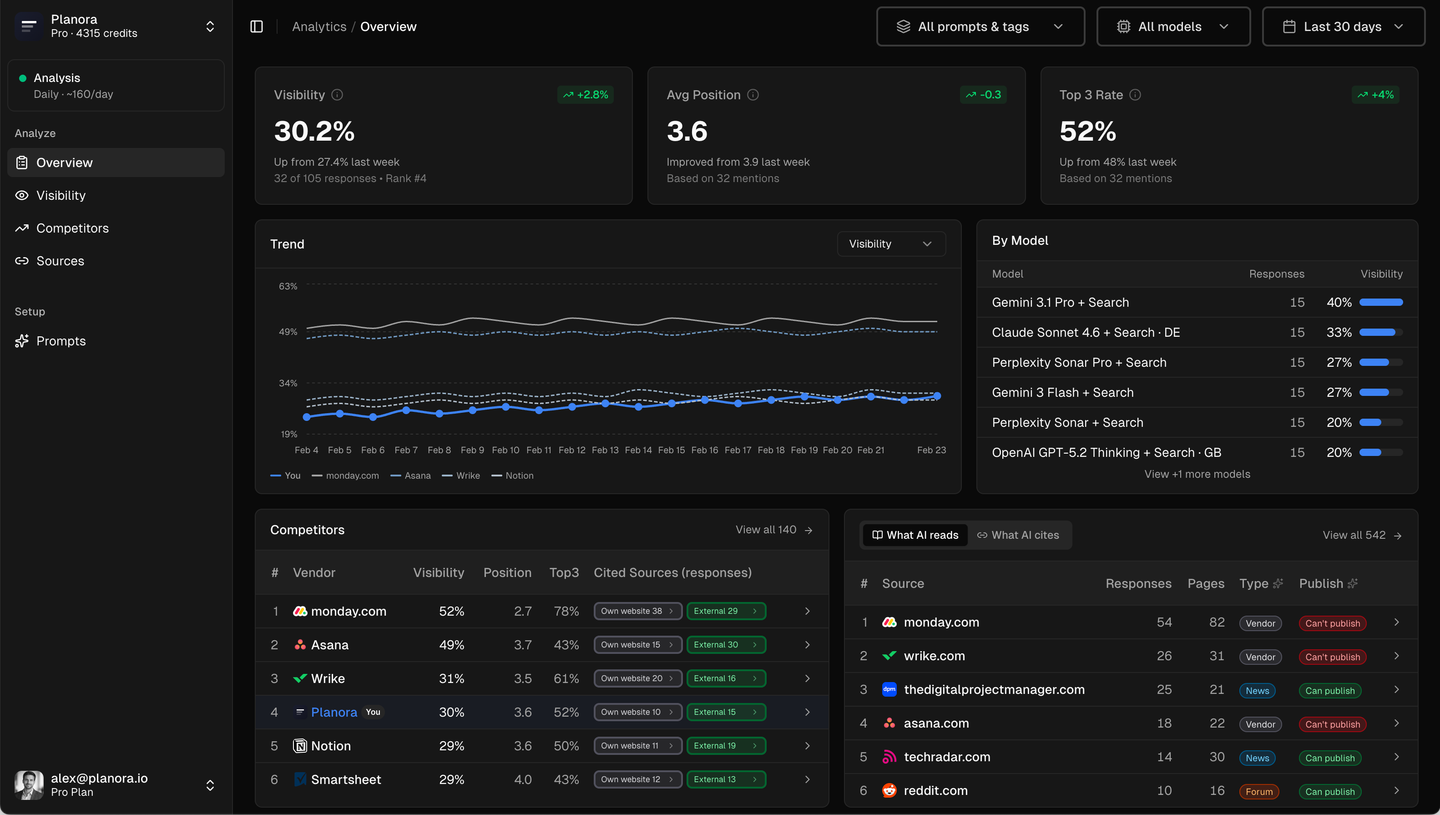
Your visibility %, average position, and top-3 rate - tracked daily as models update and competitors move. Broken down by model and region so you see exactly where you're strong and where you're invisible.
What we extract from every response
From every AI response, we extract: which brands are mentioned and in what order, what position each brand holds in the recommendation list, which sources the AI cites to justify its answer, and whether the recommendation is positive, neutral, or qualified.
We break this down model by model - because ChatGPT, Claude, Gemini, and Perplexity often give very different answers to the same question. You'll see exactly where you're strong and where you're invisible, across every major AI platform.
Know exactly where to get coverage
Which publishers does AI read before recommending brands? Which does it cite in responses? Ranked by frequency - your action list for closing content gaps. Updated daily.
How source intelligence works
AI models consume content from across the web before generating a response, and they often cite specific sources to back up their recommendations. We separate these into two categories: what the AI reads (inputs) and what it cites in the response (outputs).
For each source, we track how frequently it appears, how many unique pages are referenced, and whether it's cited for you, your competitors, or both. This gives you a clear priority list: the publications and platforms where getting coverage will directly improve your AI visibility.
Know who you're losing to - and why
See every competitor AI recommends in your category, their positions, and how they get recommended - own site, PR articles, review sites, or community content.
How competitor intelligence works
We identify every brand that appears in AI responses to your category prompts. For each competitor, we track how often they're mentioned, their average position in recommendation lists, and how frequently they appear in the top 3.
We also classify the sources that drive each competitor's recommendations - their own website, third-party review sites like G2 or Capterra, PR coverage, Reddit and community mentions, or other content. This tells you not just who's winning, but exactly what content strategy is behind their visibility.
Everything you need to win AI recommendations
Every major AI
ChatGPT, Claude, Gemini & Perplexity - where your buyers ask for recommendations.
Analyzes responses from





Your markets
AI recommendations vary by country. We query from your target regions so you see exactly what your buyers see.
Query from any region
US
GB
DE
FR
AU
...
Sources revealed
See which publishers AI reads and cites - your PR and SEO priorities that actually move the needle.
Sources citing competitors
techcrunch.com Missing
reddit.com/r/sales You're cited
Daily updates
Catch changes before competitors do. AI models update, rankings shift. You'll know first.
Recent changes
Today +2 mentions
Yesterday Competitor gained
3 days ago No change
Prompt tags
Split baseline tracking from experiments. Tag prompts to filter results and isolate what changed.
Filter by tag
Email digests
Weekly visibility shifts, competitor moves, and source gaps delivered to your inbox. No login needed.
Weekly AI Visibility Report
Visibility
70.0%
Avg Pos
1.9
Top 3
100%
Source gaps
competitor-alpha.com -5
reddit.com -3
Product names and logos are trademarks of their respective owners.
For teams who refuse to fly blind
Marketing Teams
See the gaps. Close them.
- See which competitors AI recommends instead of you
- Find the sources and content gaps holding you back
- Get a prioritized action list to improve visibility
- Track progress as you make changes
Agencies
Prove value. Find opportunities.
- Show clients exactly where they're missing (and why)
- Find high-value pitch targets competitors haven't covered
- Report on AI visibility alongside traditional metrics
- Manage multiple brands from one dashboard
FAQ
Common questions
Everything you need to know about getting started.
Our prompts are generated by a proprietary algorithm based on peer-reviewed research analyzing millions of real AI conversations (including WildChat and LMSYS-Chat-1M datasets). We generate up to five question types, weighted to match how users actually ask in the real world.
"What CRM would you recommend for a B2B startup with a 5-person sales team?"
"We're switching from Acme, what are the best alternatives for small agencies?"
The goal is simple: realistic questions your potential customers are likely asking AI when looking for products like yours.
We query the latest models from OpenAI (including GPT-5.2), Anthropic Claude (Sonnet and Opus), Google Gemini (Flash and Pro), and Perplexity (Sonar). By default, we run queries with web search enabled, but you can disable it or select specific countries (where supported by model providers) to see exactly what your customers see in their region.
AI models can produce slightly different responses each time you ask the same question. To get a more complete picture, you can configure "reruns" for each query. We repeat the request multiple times and aggregate the results, giving you a more representative view of your visibility and uncovering more content gaps and sources than a single query would.
SEO tools track search engine rankings. We track what AI assistants actually say when people ask for recommendations, including which competitors get mentioned, what sources get cited, and why. It's a completely different channel that traditional SEO tools don't cover.
AI models update frequently. Competitors publish new content. A visibility gap you closed last week might reopen tomorrow when a model retrains or new sources get indexed. Daily tracking ensures you catch changes early and can respond before competitors do.
You'll see how visible your products are across major AI assistants, who your competitors are in AI recommendations, and which content sources they're cited from that you're missing. We update the analysis regularly so you always have a current picture, and you can drill down product by product and question by question to identify exactly where to focus your efforts.
Yes. Your subscription renews monthly and you can cancel anytime from your dashboard without any fees.